✔️ 5 Year Work Guarantee*
⭐ 5.0 30+ Google Reviews
⏱️ Fast, Free Quotations
📍10+ Years Serving Cardiff
Raised & High-Rise Decking in Cardiff - Specialists in Sloped Garden Decking
Expert timber and composite raised decking installers - J&Z Fencing Cardiff
What Is Raised Decking and Do You Need It?
Many Cardiff gardens — particularly across Penarth, the Vale of Glamorgan and the hillside roads throughout the city — slope significantly from one end to the other. It's one of the most common challenges we encounter when visiting properties for a quote, and raised decking is almost always the most practical answer.
Rather than excavating tonnes of soil to create a flat area (expensive, disruptive and often structurally risky on steeper plots), a raised deck frame is engineered up from the lower end of the slope. The result is a level platform that sits above the gradient — giving you a flat, usable outdoor space that works with the shape of your garden rather than fighting it. The steeper the drop, the higher the frame needs to be at the lower end, which is where the term high-rise decking comes from.
We've been building raised decking across Cardiff and South Wales for over 10 years. In that time we've tackled everything from modest elevations of a few hundred millimetres to genuinely high-rise platforms well over a metre off the ground at the lower end, complete with full balustrade systems and integrated stairways. If your garden slopes, raised decking is very likely the answer — and we'll tell you honestly at the quote stage whether it is or isn't.
High Rise Decking Installers near me
If you are looking for high rise decking installers near me, look no further - get in contact with J&Z Fencing Cardiff, we'll be happy to help
Our Raised Decking Installations — What to Expect
No two raised decking projects are the same, which is why we always visit before quoting. The slope gradient, soil conditions, access and how you intend to use the space all shape the design. What stays consistent across every job is our approach to the structural work underneath.
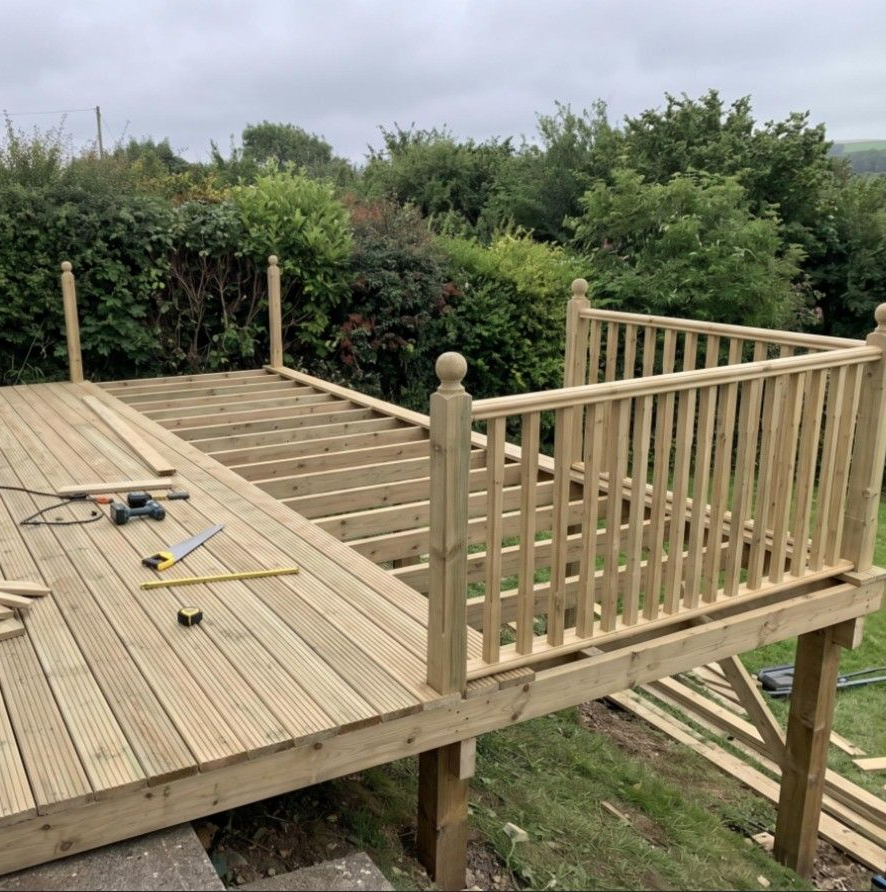
The frame is everything with raised decking. A poorly built subframe will move, drop and ultimately fail — taking your deck boards with it. We dig and concrete every post properly, size our joists for the span they're carrying, and don't cut corners on the connections between components. Once the frame is right, everything above it will last.
For the deck boards themselves we work with both pressure-treated softwood timber and composite materials depending on your preference and budget. Timber remains our most popular choice — a well-built pressure-treated softwood deck will give you 15 to 20 years of service with straightforward seasonal maintenance, and the natural wood appearance suits the majority of Cardiff garden settings particularly well.
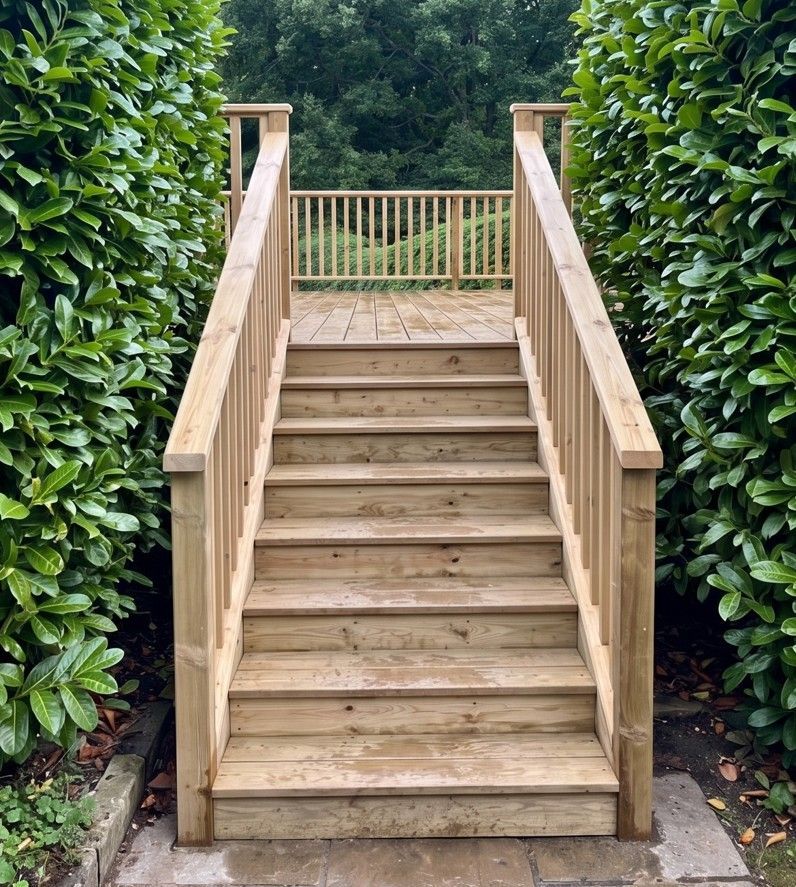
Where the elevation exceeds 600mm — which it frequently does on high-rise installations — Building Regulations in Wales require a compliant balustrade. We design and install these as part of every elevated deck project, and the balustrade choice is often what defines the overall look of the finished space. Traditional timber balustrades with spindles suit a more classic garden setting and complement the natural wooden decking boards beautifully. Frameless glass panels on stainless or powder-coated posts give a more contemporary finish and preserve the view beyond. We'll walk you through the options when we visit.
High-Rise Decking Cardiff - When the Garden Really Drops Away
Some Cardiff gardens present a serious gradient challenge — plots where the garden drops a metre or more from the house end to the boundary, particularly common on hillside roads in areas like Penarth, Cyncoed, Lisvane and across the Vale. These are the jobs that genuinely justify the term high-rise decking, and they're also the most rewarding to complete because the transformation is so dramatic.
On a steeply sloping plot the structural engineering of the frame becomes more involved. Posts need to go deeper, spans need to be calculated carefully, and the connection between the frame and the house structure needs to be properly designed. We take all of this seriously — a high-rise deck carries real loads and needs to be built accordingly.
The upside of a steep slope is that it often creates generous usable height underneath the deck, which can be enclosed for storage, plant space or even a sheltered seating area depending on the clearance available. It's worth discussing at the quote stage because a little planning at the design phase can make that space genuinely useful rather than wasted.
For very elevated decks we always recommend incorporating a proper staircase rather than simple steps — both for safety and for how the finished space feels to use day to day. A well-designed stairway down to the garden level makes the whole outdoor space flow properly rather than feeling like a platform bolted to the back of the house.
Multi-Level Raised Decking - Making More of a Sloped Cardiff Garden
On significantly sloped plots a single raised platform can feel like it ignores the rest of the garden. Multi-level decking solves this by working with the gradient rather than simply overriding it — creating two or more distinct levels connected by steps, each serving a different purpose.
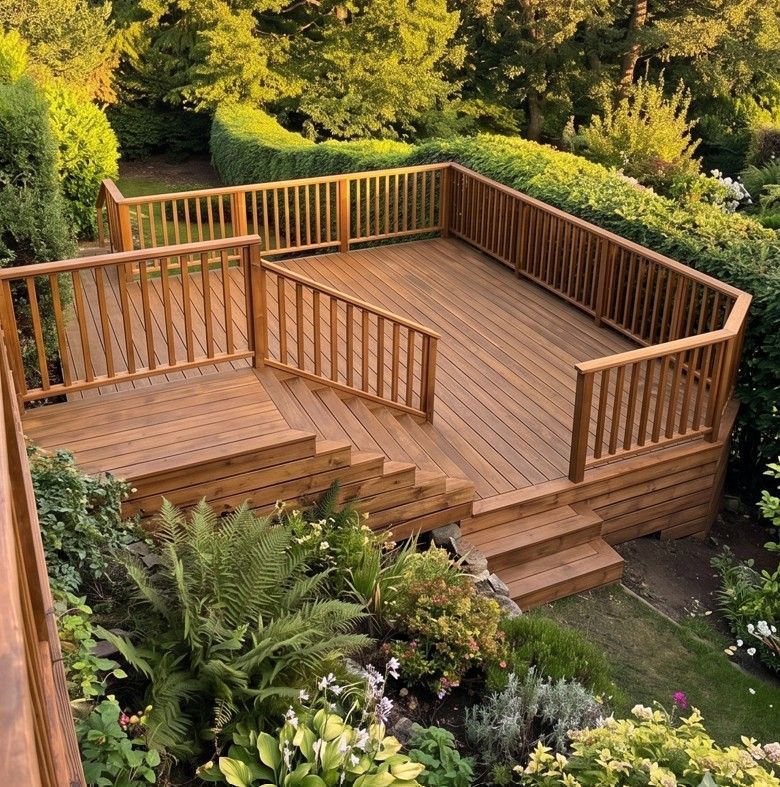
A typical multi-level arrangement might place a dining and entertaining area on the upper level directly off the house, with steps leading down to a lower level that serves as a relaxation zone, a children's play area or simply a transition space connecting to the lawn below. The different levels create natural zones without needing fences or walls to separate them, and the overall effect is a garden that feels designed and intentional rather than just flat-packed.
We've completed multi-level raised deck installations across Cardiff ranging from two modest levels with simple timber steps between them to more complex designs with wide staircases, integrated planters and balustrade systems on each level. The planning stage is where these projects succeed or fail — get the level positions and step arrangement right on paper first and the build itself is straightforward.
Timber Raised Decking in Cardiff - Our Recommendation
We work with both timber and composite decking and will always give you an honest comparison. But for raised decking specifically, pressure-treated softwood timber is our most recommended starting point for the majority of Cardiff homeowners — and here's why.
Cost is the obvious factor. Timber raised decking is significantly more affordable than an equivalent composite installation, particularly when the subframe costs on an elevated build are already considerable. For many customers the budget difference is substantial enough to make timber the clearly sensible choice.
Repairability matters more on a raised deck than a flat one. Individual boards on a timber deck can be replaced straightforwardly if one warps, cracks or sustains damage. Composite boards can be harder to match if the product line changes, and the hidden fixing systems some manufacturers use can make individual board replacement more involved.
The look is simply right for most gardens. Natural pressure-treated timber sits comfortably in a garden setting in a way that grey composite boards, however practical, don't always manage. Treated annually or every couple of years it will maintain its appearance well, and it weathers to a natural silver-grey if left untreated which many customers actually prefer.
That said, composite has genuine advantages — particularly for decks where access for maintenance is difficult due to the elevation, or for customers who genuinely want a zero-maintenance surface. We'll give you an honest steer when we visit based on your specific garden and priorities.
Building Regulations for Raised and High-Rise Decking in Wales
This catches people out more often than you might expect, so it's worth knowing the rules before you commit to a design.
Decking under 300mm above ground level generally falls within permitted development in Wales and doesn't require planning permission. Most raised decking exceeds this — often significantly — so it's worth a check with your local authority or we can advise when we visit. Cardiff Council and the Vale of Glamorgan Council handle permitted development queries and the process is usually straightforward for residential decking.
Separately from planning permission, Building Regulations apply to the structural and safety aspects of the deck itself. Any decking more than 600mm above ground level must have a compliant balustrade — in Wales this means a minimum height of 1.1 metres and designed so that a 100mm sphere cannot pass through any opening (the child safety requirement). For very elevated decks the structural loading calculations may also be required. We're familiar with all of these requirements and design every raised deck installation to comply from the outset rather than retrofitting compliance as an afterthought.
If your property is within a conservation area — which applies to parts of Penarth town centre and certain areas within the Vale of Glamorgan — there may be additional restrictions on the size and appearance of decking. Again, we'll flag anything relevant when we visit.
Raised Decking Costs in Cardiff
Raised decking costs more than flat decking at equivalent board area, and the reason is straightforward — the frame is significantly more involved. The higher the elevation required at the lower end of a sloped garden, the more structural material and labour goes into the subframe. That cost is real and we'll always be transparent about it.
As a general guide, pressure-treated softwood raised decking in Cardiff typically starts from around £150 to £200 per square metre for a modest elevation, rising to £250 or more per square metre on high-rise installations where the frame engineering is more involved. Composite raised decking will be higher — typically £300 to £500 per square metre depending on the board product chosen.
Balustrades add to the total — timber spindle balustrades are the most cost-effective option, with glass panel systems at the premium end.
These are indicative figures only. Every sloped garden is different and we always visit and measure before quoting — there's no reliable way to give a meaningful price without seeing the gradient, the access and the ground conditions. Call us on 029 2271 5157 or fill in the quote form below to arrange a free visit. We'll give you a detailed written quote with no hidden extras.
Need Help?
Frequently Asked Questions - Raised Decking Cardiff
Areas We Cover for Raised Decking
Cardiff · Penarth · Barry · Dinas Powys · Vale of Glamorgan · Caerphilly · St Mellons · Rumney